Free Consultation 24/7
Heirs’ Property and Inherited Real Estate – Application of Uniform Partition of Heirs Property Act
When families inherit real estate, the outcome can be a blessing or a source of conflict. There are lots of properties that are inherited without a will or trust, and lawyers refer to them as heirs’ property. This means that several family members are now making claims to the exact property.
In many cases, they do not have a clearly laid-out plan for using, maintaining, or sharing the property.
Ideally, co-ownership between heirs should be equitable. However, in reality, heirs’ property often creates deep divisions among families. One sibling may wish to retain the family home, while the other insists on selling. Some might provide maintenance and costs, whereas others may not. These conflicting interests are often resolved through a procedure called a partition action.
One of the most frequent types of real estate litigation is partition actions among heirs, which lies at the intersection of property law, estate law, and family relations.
It is essential to understand how such cases are initiated, how they are handled in court, and what a family can do to avoid going to court altogether in cases involving property inheritance with other family members.
Partition Lawsuits Among Heirs
A partition action is a legal proceeding that allows co-owners of real property to force a division when they can’t agree on how to manage the property. Any co-owner, even one holding a small percentage interest, can seek legal action.
In cases of inherited property, the heirs’ partition action usually arises when:
- Multiple heirs inherit a home or parcel of land together through intestacy (when there is no will) or a will that divides ownership equally.
- Some heirs want to keep the property for sentimental reasons, while others prefer to sell.
- Disputes emerge over contributions to taxes, repairs, and upkeep.
- A single heir has taken exclusive possession without fairly compensating the others.
Courts typically have two main remedies:
- Partition in Kind: Physically dividing the property among the heirs if it is practical and fair (more common with large tracts of land).
- Partition by Sale: Ordering the property sold and dividing the proceeds among the heirs, usually applied when physical division would reduce the property’s value.
Because many inherited properties are single-family homes or urban parcels that cannot be easily divided, partition by sale is often the result.
Common Family Disputes
The issue of inherited property is often much deeper than a financial conflict. They can reach out to family history, emotion, and equity. A few of the most frequent conflicts are:
- Sentimental and Financial Interests: One heir perceives the property as a family legacy that has to be maintained, and another one is more likely to consider it as an asset that has to be sold.
- Unequal Contributions: Those who bear the burden of mortgage, taxes, or repairs may feel they deserve greater compensation than others, and some may not want to compensate.
- Exclusive Use: This can occur when a single family member occupies the house without paying rent or compensating other heirs, which can lead to bitterness.
- Inequities in Inheritance: Disputes arise when heirs believe property rights are being unfairly divided, yet, legally, this is accurate under state laws of succession.
These arguments may strain family relationships over many years. The emotional and financial expenses tend to get out of control once a lawsuit is filed.
Estate Law Overlaps
Heirs’ partition action doesn’t exist in isolation. They frequently clash with estate and probate law, especially when property is held by intestacy (without a will) and when estates are open to contest.
Key intersections include:
- Probate Administration: The executors or administrators may still have to pay off liens or taxes on the inherited property.
- Intestate Succession: In the absence of a will, state law determines who inherits, typically creating multiple co-owners with minor shares.
- Estate Debts and Liens: Creditors of the estate must be paid off first, and then heirs can freely partition or sell the estate.
This overlap ensures heirs consult a lawyer as soon as possible. Our trusted, seasoned partition lawyer can provide you with high-quality assistance every step of the way, including determining the shares of ownership, resolving outstanding debts, and advising on whether partition is a wise course of action.
Legal Protections under the UPHPA
In recent years, reforms have been introduced to address the disproportionate harm partition actions have caused, particularly to minority families and heirs of rural property. The Uniform Partition of Heirs Property Act (UPHPA), adopted in more than 20 states, provides additional protections:
- Co-owners are given the right of first refusal to buy out the petitioner’s interest before a sale is ordered.
- Courts should prefer partition in kind when it is fair, rather than defaulting to partition by sale.
- Stronger notice requirements ensure that heirs are adequately informed of proceedings.
- If a sale is necessary, it must be conducted through an open-market process, reducing the risk of below-market sales at auction.
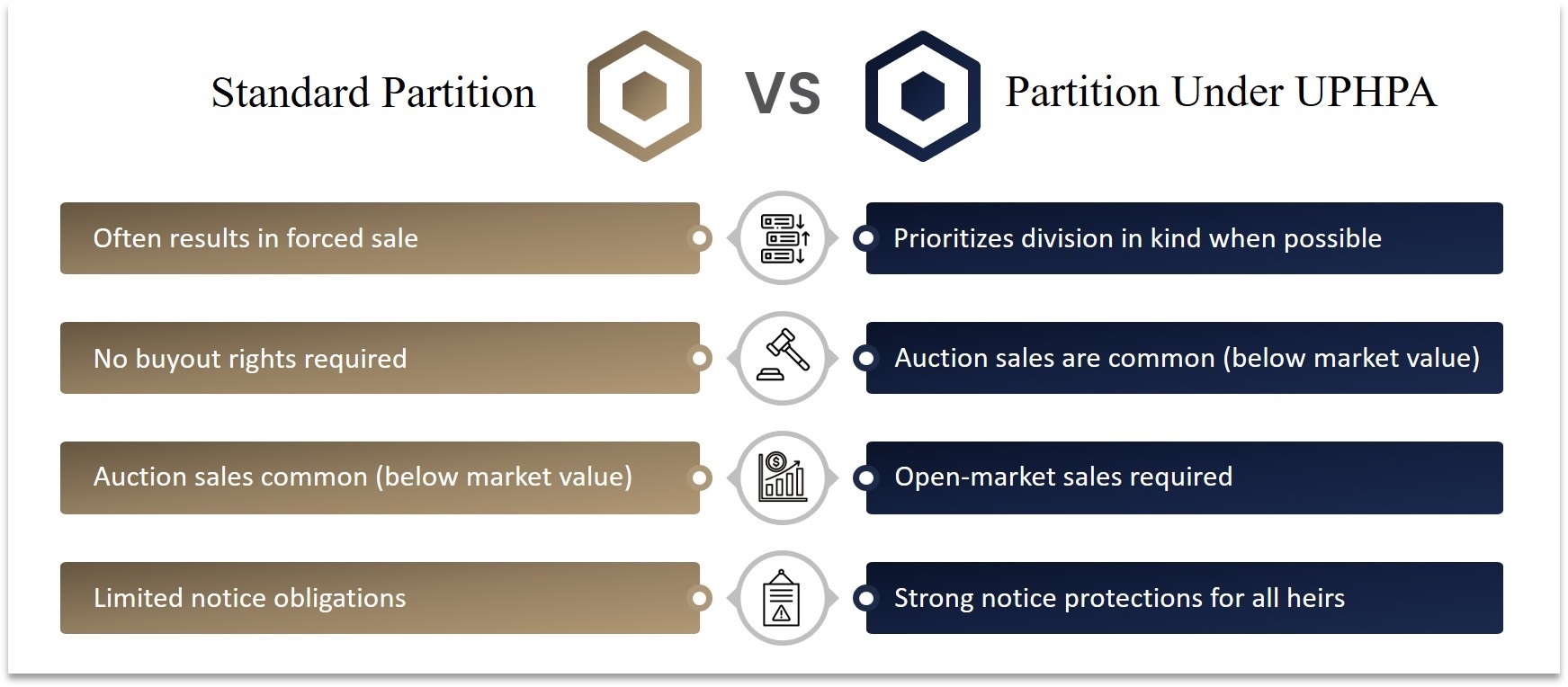
These reforms aim to preserve family wealth and protect vulnerable heirs who might otherwise lose generational property.
Strategies for Avoiding Litigation
While partition actions offer a clear legal pathway to resolve disputes, they are rarely the first choice families want to take. Lawsuits are mostly expensive and time-consuming. And once confrontation happens in court, the damage to relationships can be lifelong. Considering practical solutions outside the courtroom can save both money and relationships.
Negotiated Buyouts
In most cases, not all heirs are willing to sell the inherited property. One can regard it as a family home or long-term investment, whereas others can choose to divest their portion.
A buyout provides a compromise: the interested heir who wishes to keep the property receives the interests of those who wish to sell the property, usually at fair market value.
Voluntary Sales
A voluntary sale is the best alternative when some heirs are unable to purchase the property. This approach enables heirs to select the terms of sale, the real estate agent, and the timeline, while avoiding the additional costs and delays that often accompany court-directed proceedings.
Through co-operation, heirs can maintain control over the process and achieve maximum sales (sales under court order are sometimes hurried and may result in a smaller amount).
This can then be subdivided into the share of proceeds based on each heir’s share of ownership.
Mediation
Families in conflict can often find it easier to settle their issues through mediation. The discussions are conducted in a neutral setting, facilitated by a neutral third party with experience in law or real estate. In contrast to court, mediation is confidential, flexible, and compromise-oriented rather than confrontation-oriented.
By doing so, this will enable heirs to express their concerns (for instance, fairness, sentimental value, or financial strain) without resorting to a lawsuit.
In most situations, mediation leads to a mutually agreeable course of action, whether it involves a buyout, a voluntary sale, or a creative hybrid arrangement.
Preplanning an Estate
The best way to avoid partition disputes is effective estate planning by the original owner of the property. Wills, living trusts, and transfer-on-death deeds may clarify who inherits property and in what form.
An example of this is a parent leaving the property outright to one child and splitting the other assets among the remaining children, ensuring no co-ownership. Trusts may also appoint a trustee to administer property on behalf of the heirs, thereby avoiding disputes over its management or sale.
This process is critical when the family is emotionally attached to the property or when the jurisdictions of heirs in the property make it vulnerable (e.g., forced sales). Preemptive action saves future generations from unnecessary and expensive litigation.

Schedule a Consultation with Our Partition Lawyer Today
Heirs’ property and partition actions illustrate how family, money, and the law intersect in complex and sensitive ways. Courts provide a legal avenue to resolve disputes.
In case of a dispute on the inherited property, you must consult a lawyer at the earliest possible time. Schedule a free consultation with our expert team. Specializing in heirs’ partition action and inherited real estate disputes, our seasoned lawyer can assist you every step of the way. We are knowledgeable and experienced.
Our team relentlessly works to protect your share of the property by helping you understand your rights and guiding you toward the best legal options.
Ethical estate planning is the most effective method for planning ahead to avoid future conflicts. Clarity is crucial to prevent heirs from becoming unwilling co-owners of a property over which they cannot agree.
So don’t hold on to your dispute until you decide to file a lawsuit. If you or your family are in the process of navigating their land or considering partition action, hire us to ensure that your rights and the heritage of your family are preserved.