Free Consultation 24/7
Define Partition in Kind: The Legal Mechanism for Physical Property Division
While most modern co-ownership disputes involving residential or commercial property are typically resolved through a partition by sale, the law has traditionally favored partition in kind.
This approach is ideal for co-owners because it allows each party to retain ownership of their share of the land without being forced to liquidate the entire asset.
Winning a partition in kind is far from simple. Courts will only allow the division if it can be done fairly, without diminishing the property’s overall value or leaving one owner with an unusable portion. Although it is the legal default, these requirements make partition in kind one of the most challenging remedies to implement.
What is a Partition in Kind and the Fundamental Requirements?
A partition in kind is a judicial order that physically divides one parcel of land into multiple smaller, separate parcels. Each co-owner then receives title to their proportionate share of the original property.
The Law’s Preference for Physical Division
Usually, courts would choose partition in kind over partition by sale during co-ownership disputes, as it respects the traditional view that owners should be allowed to preserve their property rights even if the co-ownership arrangement must be terminated.
The Threshold Requirement: Proving No Prejudice
While the law often presumes partition in kind when feasible, parties seeking a partition by sale must usually demonstrate that a physical division would cause substantial prejudice or be impracticable. That co-owner must prove to the court that the physical division is not only feasible but that it will not cause “great prejudice” to any of the co-owners.
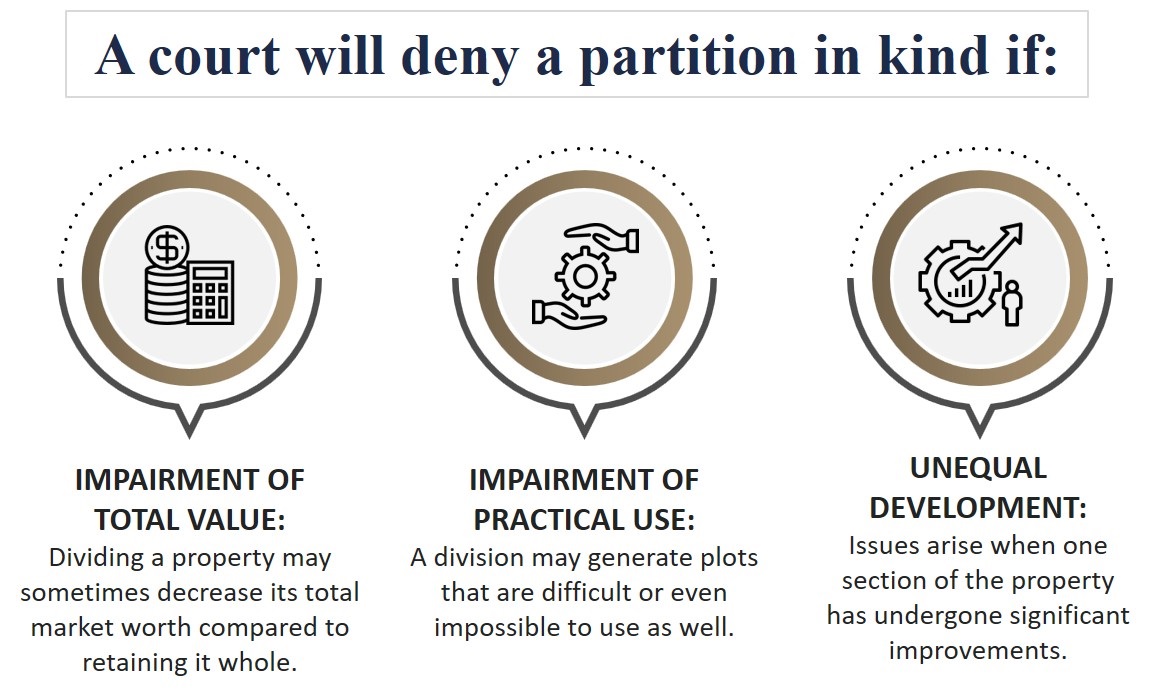
A court will typically deny a partition in kind if:
- Impairment of Total Value: Dividing a property may sometimes decrease its total market worth compared to retaining it whole. Courts often reject a partition in kind when it results in a financial loss; for example, a 50-acre farm can lose its value significantly if divided into two 25-acre farms.
- Impairment of Practical Use: A division may generate plots that are difficult or even impossible to use as well. One owner could wind up with land without access to roads or utilities, or that fails to meet local zoning regulations. Such land loses worth, and hence, the court is unlikely to authorize the separation.
- Unequal Development: Issues arise when one section of the property has undergone significant improvements, such as a house on one side, while the other side remains undeveloped. The court might attempt to strike a balance by considering substantial cash payments from one co-owner to another. But the division becomes impossible if the required payments are too outstanding.
Appraisals and Achieving Equitable Division
Once the court determines that physical division is legally and practically possible, the next step is to ensure that the resultant parcels are equitable. This means that they are fair in value with respect to each owner’s original percentage interest.
“Equitable” does not necessarily mean “equal in size,” especially if the land has varied terrain or features.
The Use of Court-Appointed Commissioners
Unlike a partition by sale, which uses a partition referee to manage the sale, a partition in kind often requires the appointment of commissioners. The court appoints neutral experts, such as surveyors, appraisers, or land planners, to survey the property, create a map, and recommend a fair division. This includes:
- Detailed Appraisal: They request a comprehensive evaluation of the entire property, focusing on specific characteristics that influence value, including road access, frontage, mineral deposits, lumber, water rights, zoning, and proximity to utilities.
- Survey and Platting: They are responsible for conducting surveys and creating subdivision maps, which specify the new boundaries for each intended part.
- Lot Assignment: The commissioners develop a recommendation for assigning specific parcels to specific owners, matching the value of the parcels to the co-owner’s fractional interest.
The Use of Owelty (The Equalizing Payment)
It is scarce, even for raw land, that physical division results in parcels of perfectly equal market value. To address these small-value differences, courts use a mechanism called the owelty of partition.
Owelty is a court-ordered, legally enforceable payment used to equalize the final value distribution. It is primarily a monetary transaction from the co-owner who gets the more valuable property to the co-owner who receives the less valuable property.
Example: Co-owner A with 50% interest gets a parcel valued at $550,000, and Co-owner B, who also has 50 percent interest, gets a parcel at $450,000. Co-Owner A would then pay Co-Owner B $50,000 in owelty to equalize their total interest to $500,000 each.
The owelty payments are crucial, but if the requested cash payment is too high, the court may view the general partition as too complicated or prejudiced.
Common Challenges and Practical Obstacles
Although Partition in Kind is the preferred legal theory, the practical issues of land use, zoning, and value make it quite challenging to accomplish the desired result in most cases.
The Challenge of Zoning and Land Use
Local zoning ordinances are the single most frequent reason for denying partition-in-kind requests. Strict minimum lot sizes, frontage requirements, and setback rules imposed by several jurisdictions make legal subdivision of a property impossible.
- Minimum Lot Size: If a zoning rule specifies a 5-acre minimum and the co-owners are partitioning a 7-acre parcel 50/50, the resulting 3.5-acre lots will be illegal nonconforming parcels, thereby forcing the court to dismiss the physical division.
- Access Issues: Ensuring legal and delegated public road access for every parcel is challenging and expensive. It often requires the dedication of easements that decrease the land’s value and further limit the developable area.
The Problem of Unequal Development and Improvements
The most difficult challenge arises when the property is not purely raw land but contains substantial improvements, such as a well, septic system, utility hookups, or a primary structure.
Suppose the primary residence sits entirely on one half of the proposed division. In that case, the court must value that entire structure and then use a massive owelty payment to compensate the co-owner who receives the bare land.
Erosion of the Absolute Right (UPHPA/PRPA Legislation)
Recent legislative trends, notably the adoption of the Uniform Partition of Heirs Property Act (UPHPA) in many states, have subtly shifted the landscape to protect families who own inherited property (Heirs Property).
Under UPHPA, if a co-owner files a Partition Action involving Heirs Property, the court must presume that a partition in kind is the appropriate remedy.
This guideline can, however, be set aside if the co-owner requesting a sale demonstrates that splitting the property would render the plots unusable or would cause greater harm than selling the entire property. This legislation provides a stronger defense against a forced sale but does not eliminate the physical and economic requirements of the division.
These complex property issues require clear legal solutions. Reach out to our partition attorneys now for trusted guidance. We can provide you with the best course of action needed to protect your equity and future.
Partition in Kind vs Partition by Sale
Understanding which is most likely for your property is vital for preparing your legal strategy. The table below clearly outlines the key distinctions between the two partition types.
| Feature | Partition in Kind (Physical Division) | Partition by Sale (Forced Sale) |
| Court Preference | Theoretically preferred (especially for raw land) | Most commonly ordered in practice |
| Prerequisite | Must prove the division causes no harm and is physically feasible | Must prove the division causes great harm or is impractical |
| Asset Outcome | Ends with co-owners holding separate title to individual parcels. | Ends with co-owners holding separate cash proceeds from the sale. |
| Mechanism of Division | Court-appointed commissioners (surveying and platting) | Court-appointed partition referee (selling and financial accounting) |
| Financial Equalization | Achieved through owelty of partition (cash payment to equalize lot values) | Achieved through judicial accounting (credits/offsets for expenses paid) |
| Applicable Property | Primarily raw, undeveloped, or large tracts of land. | Residential homes, condominiums, commercial buildings, and most improved properties. |
| Likely Outcome | Low probability for most property types. | High probability for most property types. |
Partition in kind aims to preserve property ownership. In contrast, partition by sale seeks to maximize the asset’s financial value, which is why the sale process dominates co-ownership litigation today.
Why Legal Representation Matters in Partition in Kind Cases
Partition in kind requires a fair division, property valuation, and adherence to zoning regulations. Co-owners take the risks of losses, delays, or adverse judgments if they lack qualified legal counsel.
An experienced owner can challenge impractical divisions that reduce property value. Whether you are seeking physical division or defending against it, strong legal counsel ensures that your interests are protected, and the outcome preserves both your rights and property value.
Strategic Counsel for the Right Partition Remedy
Successfully navigating a partition action, whether you are seeking physical division or arguing against it, requires detailed knowledge of real estate valuation, local zoning codes, and complex equitable theories, such as owelty.
While partition in kind remains the legal default for physical division, the economic realities often dictate that a partition by sale is the most practical and financially responsible option for all co-owners.

Schedule a free consultation with our experienced partition attorney.
Don’t risk the value of your property without proper legal guidance. We can help you evaluate whether a physical division is possible or if a partition by sale is the better approach in your case.
Get a confidential legal review and see how our legal experts can protect your property rights!