Free Consultation 24/7
Understanding Florida Partition Lawsuits and Your Rights
The Core Purpose of a Partition Action
Disputes are almost certain to happen when more than two people co-own a piece of property. One person may wish to sell; another may want to preserve the house.
Co-owners may believe they are bearing more than their fair share of costs; relatives inheriting property may not see eye to eye about what to do with it. Florida’s partition law offers co-owners a remedy in these circumstances: a partition action.
A partition action in Florida is a legal process to settle disagreements among co-owners. It applies when they are unable to agree on how to use, control, or dispose of shared property.
Under Florida partition law, no one can be compelled to remain indefinitely in a co-ownership relationship against their will.
Instead, the law provides a clear path for resolving conflicts of interest, either by equitable physical separation of the property (partition in kind) or, when that is impractical, by a judicially ordered sale with the proceeds split among the owners.
Real-world scenarios include partition actions:
- Inherited property: siblings inherit a family home but cannot agree on whether to sell it or keep it.
- Divorce cases: when ex-partners still own the property but disagree on how it should be used.
- Business partnerships: Disagreement between investors or real estate partners regarding the sale or management of the property.
For co-owners of real property in Florida, understanding this procedure is vital to safeguarding your rights. You have the legal right to request that the court intervene if you own property with someone else and disagree on its future.
Under Chapter 64 of the Florida Statutes (2025), any co-owner may petition for partition; the court will either fairly distribute the property or order a deal with profits divided among the owners.
When Co-Ownership Fails: The Legal Necessity for Division and Sale
In Florida, real estate co-ownership may seem convenient initially, but disputes often arise later when life circumstances change. Divorce or separation may lead to disputes over the fate of a shared home.
Inheritance situations may create friction among siblings or heirs when not everyone agrees on whether to keep or sell family property. Real estate ventures between business partners in which investment goals no longer align with their objectives.
The Florida partition law allows a co-owner to file a partition action, ensuring that property disputes are resolved fairly and legally.
The primary purpose of a partition action is to end uncertainty in shared ownership. The court may divide the property among the owners or order a sale, with the proceeds shared fairly. Filing a partition action complaint protects each co-owner’s rights, preventing anyone from being forced to remain in a strained situation.
The process provides balance and closure when no mutual decision can be made.
Legal Authority: Overview of Florida Statutes Governing Partition
The statutory authority for partition actions in Florida is guided by Chapter 64 of the Florida Statutes, which sets out the framework and powers governing how courts handle the division or sale of co-owned property. The law under Chapter 64 provides for steps such as filing a complaint, and the court may appoint commissioners to propose an allocation.
Florida has also adopted the Uniform Partition of Heirs Property Act (UPHPA) into its section (Florida Statutes 64.201–64.214) to govern inherited property disputes. The UPHPA takes precedence when the property is inherited and qualifies as “heir’s property. ” It ensures that heirs are offered buyout opportunities, preventing them from losing family land too quickly through forced sales.
Alongside Chapter 64, the UPHPA strengthens the legal framework, providing co-owners with additional protections and ensuring a fair and transparent process.
Elements of Partition Action in Florida: How to Initiate the Complaint
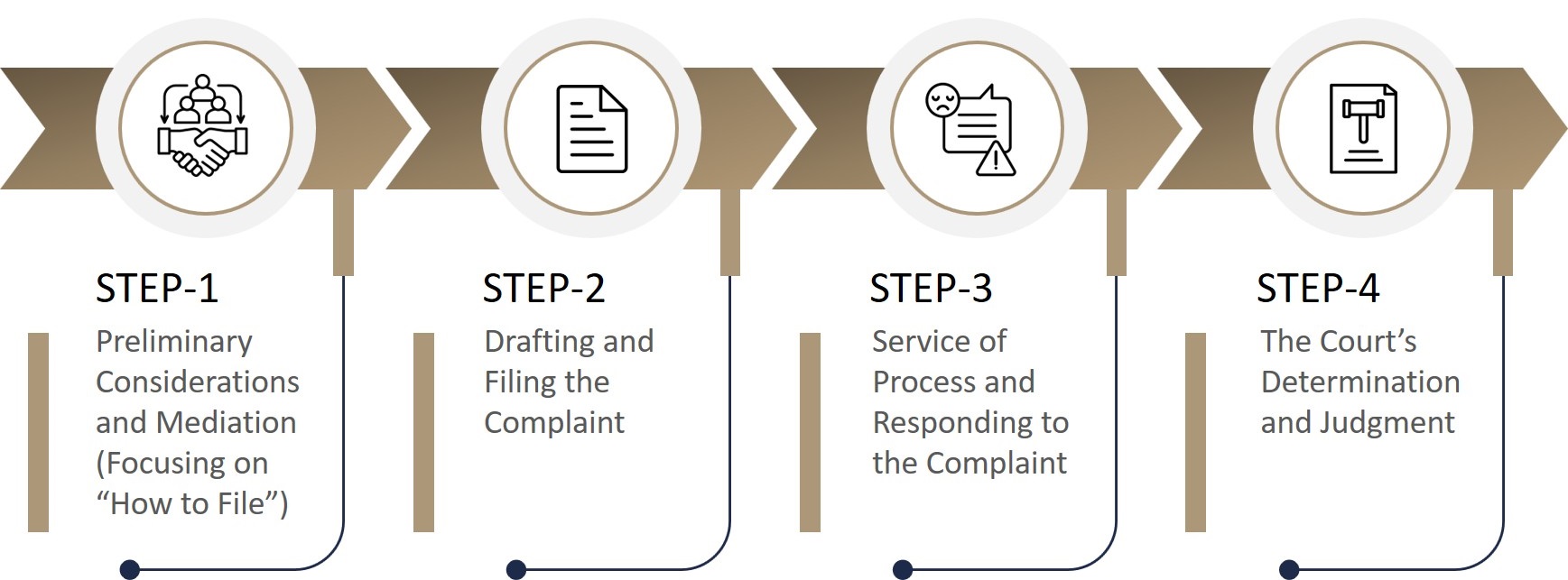
Step 1: Preliminary Considerations and Mediation (Focusing on “How to File”)
Before initiating a partition action in Florida, it is crucial to verify the legal basis for the claim. Anyone filing must demonstrate that they hold proof of ownership, typically through legal documents such as deeds or inheritance records.
Courts require this confirmation to ensure that they proceed with clear evidence of title. Additionally, every co-owner and creditor with rights in the property must be identified in the complaint, regardless of the size of their interest. Leaving out a co-owner, lienholder, or mortgage company can delay or even dismiss the case.
The Florida partition law does not mandate mediation before filing a lawsuit, but courts strongly encourage it. Through mediation, co-owners can settle disputes outside of court, such as dividing proceeds from a buyout or a private sale.
This option is typically quicker and more affordable than a court trial. Even when disputes remain, mediation creates a smoother path for the case. Making a genuine attempt at settlement first, co-owners show cooperation, which can weigh favorably in the proceedings.
Step 2: Drafting and Filing the Complaint
The next phase after the initial steps is filing a Partition complaint in the Florida court with jurisdiction over the land. The complaint should state each party’s ownership stake, list all co-owners or interested parties, and contain a thorough legal description of the property.
It must also explain why the owners were unable to reach a voluntary resolution, such as disagreements over selling, splitting, or running the property. Based on the property’s location, the filing is made in the county’s circuit court. Avoiding problems or delays caused by opposing parties depends on strong drafting.
Step 3: Service of Process and Responding to the Complaint
Under Florida partition legislation, service of process is a crucial initial step after the complaint is filed. This means that every co-owner and lienholder will be served with a summons and a copy of the petition. The court may enter a default judgment against a co-owner who fails to respond. The partition process proceeds without their assistance in these situations, so they lose the opportunity to contest the conditions of the partition or sale.
Step 4: The Court’s Determination and Judgment
After reviewing the case, the court issued two critical findings. First, it rules on whether the property is legally subject to partition. If the court rules in favor of the partition, it is a kind of division where the property itself is divided into separate portions that reflect each owner’s interest. A partition in Kind physically divides the land, giving each co-owner an individual piece of property that is allocated to their ownership share.
Partition by Sale occurs when division is impractical and involves selling the property and dividing the proceeds. Here, the property is sold under court supervision, and the proceeds are distributed among the co-owners after the contribution claims have been settled.
Unique Considerations in Florida Partition Suits
Partition actions in Florida face unique challenges when the property qualifies as a homestead. Florida’s Constitution shields homestead property from certain forced sales, particularly when minor children or a surviving spouse occupy the residence. The law typically exists to prevent families from losing their homes.
The court will not order a sale that violates these protections. However, partition may still be possible in certain situations, such as when children are no longer minors or if a surviving spouse agrees to the action.
For co-owners, this means that a partition action involving homestead property is subject to heightened scrutiny.
The Owelty Liens and Equalizing Shares
Florida courts apply the owelty lien method in partition actions if dividing property evenly is not possible. This lien works as a balancing tool. If one co-owner receives more than their rightful share, they must compensate the others. This ensures that each party gets equal value and prevents one owner from gaining an unfair advantage.
Partition of Inherited Property (UPHPA Compliance)
Florida has adopted the Uniform Partition of Heirs Property Act (UPHPA) to handle multi-entity inherited property disputes. It sparks conflict among heirs, especially when some want to keep the property, and others wish to sell.
Courts must follow special procedures under this act, which requires that all heirs be notified of the proceeding.
Before the property is sold, offers are extended to co-owners, giving them the first opportunity to purchase shares from relatives who wish to sell. This process strikes a balance between the desire to maintain ownership of ancestral property and promotes cooperative solutions.
Accounting and Contribution Claims
Under the Florida partition law, the court requires an accounting to determine financial contributions made during the period of joint ownership. If one co-owner shouldered these obligations that benefited all, including property taxes, mortgage installments, or necessary upkeep.
They may file a contribution claim and are entitled to reimbursement or credits against ownership shares. This step is essential to protect co-owners who are maintaining the property on behalf of all.
Cost of Partition: Who Pays for Partition Action in Florida?
Allocation of Court Costs and Attorneys’ Fees (Addressing the Target Intent)
In a partition action in Florida, costs and attorneys’ fees become significant issues. The court has discretion in awarding these expenses in accordance with Florida Statute § 64.081.

Typically, each co-owner pays their own legal fees; however, the court has discretion to apportion costs as the case unfolds.
Under the common benefit rule, reasonable attorneys’ fees are to be paid directly from the property’s sale proceeds. Suppose the legal services benefit all co-owners. Florida courts aim to divide both property and expenses equitably through this approach.
Recovering Costs from the Sale Proceeds
The question often arises: Who pays for a partition action in Florida? Typically, the costs are not borne by a single co-owner. It is usually paid from the property itself.
This means the court requires expenses such as filing fees, surveyor, and appraisal costs to be deducted from the sale proceeds. Covering expenses through the sale itself prevents disputes about out-of-pocket payments.
The Role of Bad Faith or Unreasonable Opposition
Florida courts expect co-owners to act fairly and reasonably in partition cases. If a party needlessly prolongs the case, refuses to cooperate, or acts with bad faith intent, the court may penalize them to bear a larger portion of the attorney’s fees and court costs. This discourages obstruction and protects the rights of cooperative parties.
Judicial Requirements and Conclusion
Florida Court Requirements for the Sale and Distribution
When a Florida court orders a partition by sale, the process follows strict guidelines. It may appoint a Special Magistrate or Commissioner to manage the process, ensuring fairness and transparency. The sale itself can take place at public auction or through private negotiation under court supervision.
The court then reviews all costs and obligations, including attorney fees, mortgages, taxes, and other necessary expenses, before dividing the balance among the parties.
Summary of Key Takeaways: How to Win a Partition Action in Florida
The partition process in Florida follows a clear structure, which includes confirming ownership, naming all necessary parties, considering mediation, and proceeding with court oversight. Whether through partition in kind or by sale, the court ensures fairness by distributing proceeds after costs and claims are settled. As the process involves complex statutes and procedural rules, working with a skilled Florida partition attorney is the most effective way to protect your share of the property.
Frequently Asked Questions (FAQs)
Can I force the sale of a property I jointly own?
Indeed. According to Florida partitioning legislation, should you disagree with the other owners of property, you could bring a partition lawsuit. The court will decide whether the property must be sold (partition by sale) or if it can be physically split (partition in kind). Should a deal be executed, the earnings are distributed among the co-owners in proportion to their ownership stakes.
How long does a partition action in Florida typically take?
The complexity of the case, the level of party cooperation, and whether the court orders a physical division or a sale determine the timeline. While contested actions can take a year or more to resolve, simple cases can often be settled within several months. Often, delays occur when appraisals, polls, or arguments over charges and contributions are present.
Is a partition the same as a quiet title action?
No. Two distinct legal procedures are partition actions and quiet title actions. Co-owners who want to split or sell jointly owned property employ partition. Quiet title, by contrast, settles ownership conflicts or corrects flaws in the chain of title.